What to Eat in Jilin: A Foreigner's Food Guide
Eating in Jilin in 30 seconds
- The cuisine: Dongbei (Northeastern) food — hearty, salty-sour, served in generous portions built for −20°C winters. If you know Bavarian winter food — sausages, pickled cabbage, dumplings, beer — you already understand the Dongbei table. Same climate logic, different continent.
- Must-tries: guobaorou (锅包肉), suan cai stewed pork, Korean-style cold noodles, Manchu hotpot, and the street snack jianfen (煎粉).
- Where: neighborhood diners for the real thing; snack streets for grazing; hotel restaurants if you want English menus.
- Ordering: menus are Chinese-only outside hotels. A translation app with camera mode is essential — plus pointing, smiling, and the phrase zhege (这个, “this one”).
The dishes you came for
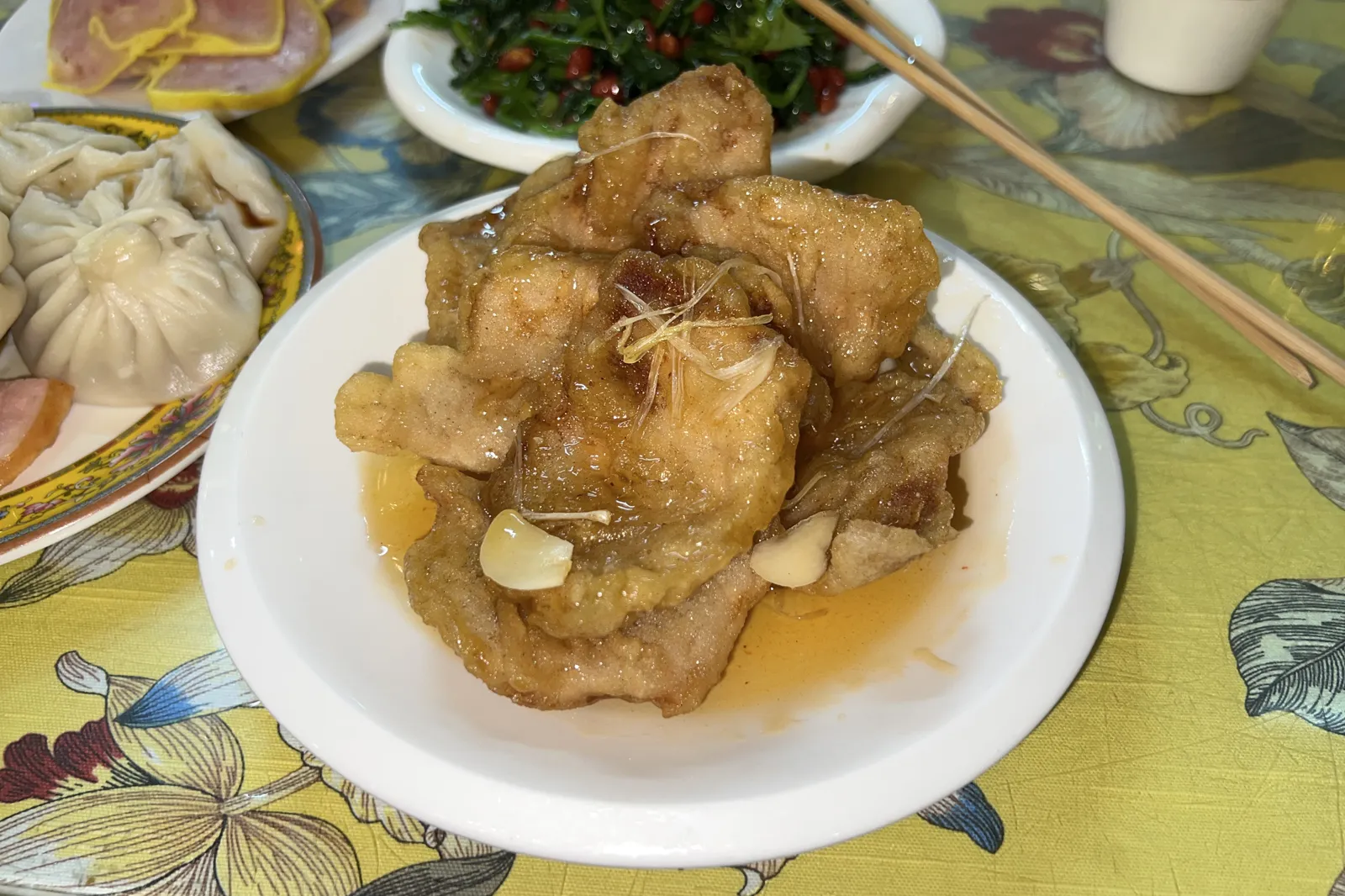
Guobaorou (锅包肉) — sweet-and-sour crispy pork. Jilin’s signature dish and a point of local pride: thin slices of pork, fried crisp, glazed in a translucent sweet-sour sauce with shredded carrot and scallion. Think of it as sweet-and-sour pork the way it was always meant to be — shattering crisp, never the gloopy red stuff. Order it everywhere; compare versions like a local.
Suan cai stewed pork (酸菜炖肉). Pickled cabbage slow-stewed with pork belly, sometimes with blood sausage (血肠). Think sauerkraut’s Chinese cousin — both were born from the same survival logic: fermenting cabbage to get through winter. The difference: suan cai is typically milder and less vinegary, and where sauerkraut usually plays backup, here it is the main event — simmered long until silky, carrying the whole stew. Sour, fatty, warming — the dish Northeasterners miss most when they leave home. Peak season is winter, when every family has its crock of fermenting cabbage.
Bairou xuechang (白肉血肠) — “killing the pig” feast. White boiled pork with garlic dipping sauce plus blood sausage — think Germany’s Blutwurst meeting Northeast China. But here it isn’t a breakfast sausage: it arrives sliced into a bubbling stew at the center of the sha zhu cai feast, lifted out piece by piece with garlic dip. Same blood-sausage instinct, completely different ritual. Rich, unapologetic, unforgettable.
**Cold noodles (冷面). ** If you’ve had Korea’s naengmyeon, you’ll recognize it instantly — Jilin’s Korean community serves it the Yanbian way: chewy buckwheat noodles in ice-cold beefy broth, kimchi, half a boiled egg. The perfect antidote after days of heavy winter food — and excellent in summer.
Manchu hotpot. A copper pot of bubbling broth with pickled cabbage, blood sausage and sliced meats, eaten in Wulajie Manchu Town or old-style restaurants in the city. Distinct from Sichuan or Beijing hotpot — sour and savory rather than spicy.
Jianfen (煎粉) — the street snack. Jilin’s beloved sidewalk food: starch jelly sliced and pan-fried crisp, tossed with chili oil, vinegar and savory sauce. There is no Western equivalent for this one — chewy, crisp, sour-spicy all at once — and that is exactly why you should try it. Find it at snack stalls and the jianfen snack street. Costs almost nothing; tastes like the city.
Dumplings (饺子). Dongbei runs on dumplings — pork and cabbage, pork and suan cai, lamb and scallion. A plate of twenty with black vinegar is a complete, honest meal.
Songhua Lake fish. White fish and fathead fish from the lake, steamed simply or stewed in an iron pot with tofu and glass noodles. Order it when you’re at the lake; in the city, look for restaurants advertising lake fish.
🔊 Pronunciation guide
Tap to hear each word (AI-voiced Mandarin demo — listen and repeat):
- 锅包肉 — sweet-and-sour crispy pork guōbāoròu
- 酸菜 — pickled cabbage suāncài
- 白肉血肠 — white meat & blood sausage báiròu xuècháng
- 冷面 — cold noodles lěngmiàn
- 煎粉 — pan-fried starch jelly jiānfěn
- 这个 — “this one” (point at the dish you want) zhège
- 买单 — “the bill, please” mǎidān
- 谢谢 — “thank you” xièxie
Where to eat
- Neighborhood diners (小馆子/家常菜). Where locals actually eat: plastic stools, laminated photo menus (sometimes), the best guobaorou of your trip. Dinner crowds peak 6–8 PM.
- Snack streets. Grazing territory — jianfen, grilled skewers (chuan’r), fried snacks, sweet tofu pudding. Go hungry, go early evening.
- Hotel restaurants. English menus exist here and nowhere else, at 2–3× the price. Fine for your first night while you calibrate.
- Wulajie Manchu Town. Worth the trip for Manchu hotpot in its home setting — combine with a Rime Island day.
A note on names: specific restaurant recommendations go stale fast and depend on your neighborhood. Ask your hotel front desk for “fujin haochi de dongbei cai” (附近好吃的东北菜, “good Dongbei food nearby”) — front desks love this question.
How to order without Chinese
- Translation app, camera mode on. Point at the menu; it won’t be perfect, but “crispy pork” vs “pig intestines” is a distinction worth making.
- Point at other tables. See something good go by? Point and say zhege (这个). Universally understood.
- Photos help. Keep phone photos of dishes you want to try; show the waiter.
- Key phrases: zhege (这个, this one), maidan (买单, the bill), duoshao qian (多少钱, how much), bula (不辣, not spicy — rarely needed in Dongbei, but useful).
- Portions are large. One dish per person is plenty; two people order two or three dishes to share. Family-style sharing is the norm.
Good to know
- Meals are social. Dishes arrive for the table, not per person. Rice comes in individual bowls; everything else is shared.
- Baijiu culture. Strong sorghum liquor may appear at business or festive meals. A polite sip-and-decline is fine; nobody will force you.
- Vegetarians: be honest with yourself — Dongbei cooking leans heavily on pork. Buddhist-style restaurants (sushi 素食) exist but are uncommon; cold noodles and dumplings with vegetable fillings are your safest bets.
- Water: don’t drink tap water. Bottled water is everywhere and cheap; hotels provide kettles.
- Breakfast: join the morning crowd for tofu pudding (doufunao), fried dough sticks (youtiao) and steamed buns — breakfast streets wake up early and wind down by 9.
FAQ
Is Jilin food spicy? Generally no — Dongbei food is salty, sour and savory rather than hot. Chili appears as a condiment (especially on street snacks), not as the base of the cuisine.
How much does a meal cost? A filling local dinner runs roughly 30–80 RMB per person at neighborhood places; hotel restaurants cost two to three times that. Street snacks are pocket change.
Can I drink the tap water? No. Drink bottled or boiled water only.
I don’t eat pork — will I survive? It takes effort. Pork and lard are foundational. Learn to say wo bu chi zhu rou (我不吃猪肉, “I don’t eat pork”) and lean on cold noodles, vegetable dumplings and egg dishes.
What’s the one dish I shouldn’t miss? Guobaorou. It’s the dish the city is known for, and the gap between a great version and a mediocre one will recalibrate your standards for sweet-and-sour pork forever.