Jilin Street Food Guide: What to Eat on the Street
The essentials in 30 seconds
- Jilin’s street food is daytime food: breakfast stalls, snack streets, and winter vendors selling hot things to cold hands. Our night markets guide covers the after-dark half; this is the other half.
- Eat first: jianfen (煎粉), the pan-fried jelly noodles only Jilin does this way; chuan’r (串儿) skewers off charcoal; tanghulu (糖葫芦), hawthorn berries in a crackling sugar shell, the winter icon.
- Cost: pocket change. Most snacks run a few yuan apiece; a full grazing lunch rarely breaks 30. See the budget guide for the math.
- Ordering: point, hold up fingers, pay by phone. “这个” (zhège, “this one”) plus a smile covers nearly everything. Menus barely exist at this level, which is the point.
Street food, night markets, restaurants: which is which
Three different animals, and visitors mix them up:
- Restaurants serve the famous dishes: guobaorou, suan cai stew, Manchu hotpot. Sit-down, shared plates, the food guide has the full list.
- Night markets are the evening spectacle: grills, lanterns, folding tables. See the night markets guide.
- Street food is what this page is about: the daytime and shoulder-hours layer. Breakfast tofu pudding at 7 AM, jianfen sizzling at noon, a roasted sweet potato warming your gloves at 4 PM in January. Less spectacle, more daily life. This is the layer locals actually live on.
The lineup: what to actually eat
Jianfen (煎粉): start here. Starch jelly sliced and pan-fried crisp, tossed with chili oil, vinegar, and savory sauce. Chewy, crisp, sour-spicy at once. Jilin’s sidewalk signature, and the one item on this list with no Western equivalent, which is exactly why it leads. Our food guide explains the obsession; the short version is that you have not understood this city until you have eaten it standing up.
Chuan’r (串儿): charcoal skewers. Lamb, chicken wings, squid, mushrooms, mantou bread, all over real charcoal with cumin, chili, and salt. If you know Japanese yakitori, you have the shape of the idea. The cousin-not-twin part: yakitori is precise and restrained; chuan’r is louder, smokier, ordered by the dozen, eaten at plastic stools with the smoke in your jacket for the rest of the day. Same skewer instinct, completely different evening.
Kao lengmian (烤冷面): grilled cold noodles. The Korean-Chinese street classic: chewy cold-noodle sheets griddled with egg, sausage, and sweet-spicy sauce. A different dish from the cold noodle soup in restaurants. This is its scrappy street sibling, and it is better than it has any right to be.
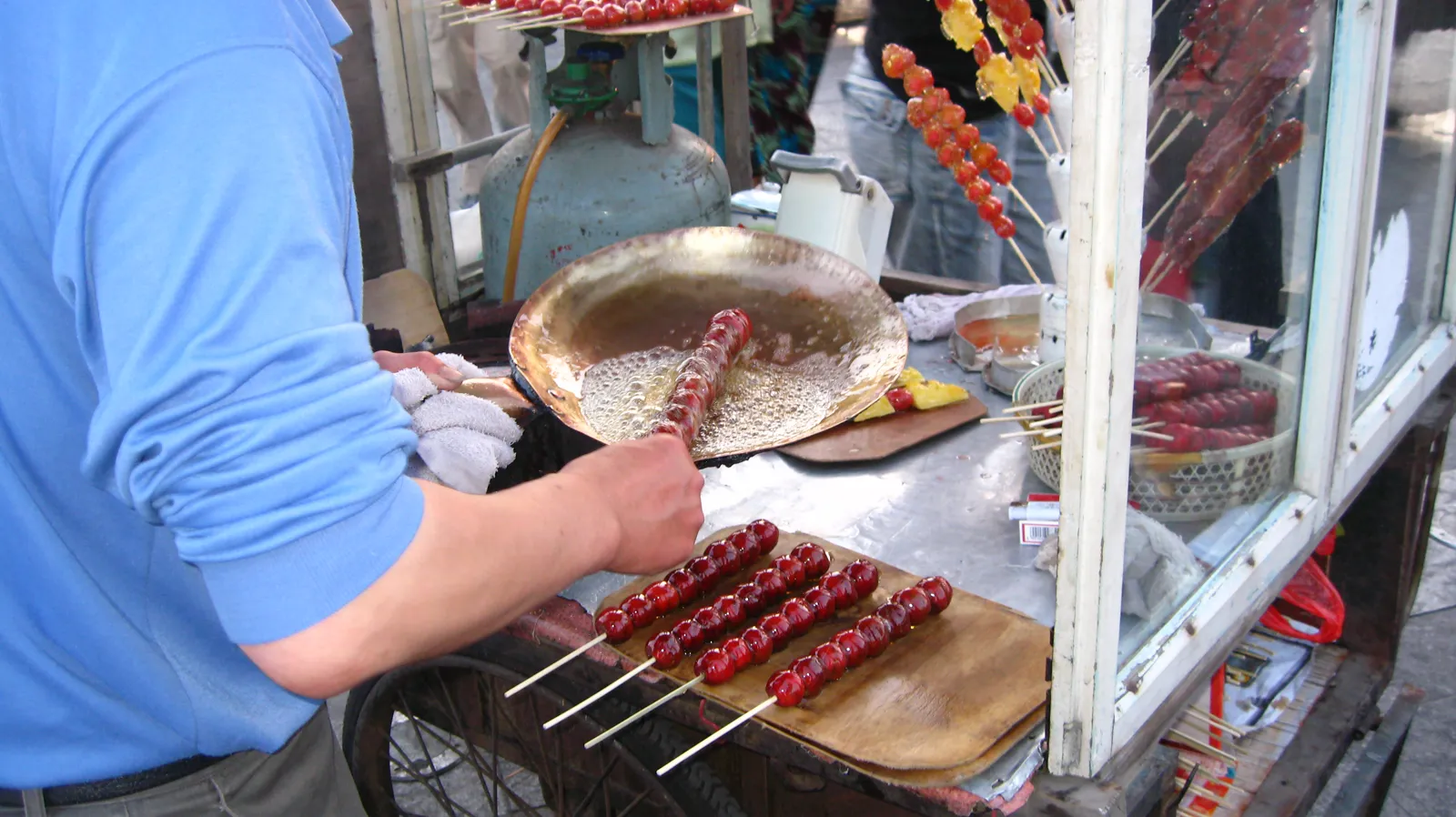
Tanghulu (糖葫芦): candied hawthorn. Skewers of red hawthorn berries dipped in hardened sugar syrup, sold from carts and bicycle vendors all winter. Think of the toffee apple at a Western fair. The cousin-not-twin part: a toffee apple is sweet on sweet; hawthorn is mouth-puckering tart under that glass shell, and you eat it with numb fingers in freezing air while the vendor tends a brazier. It is the taste of a northern Chinese winter, and it photographs beautifully.
Kao digua (烤地瓜): roasted sweet potato. Winter’s hand warmer. Vendors roast them in oil-drum ovens until the skin blackens and the inside turns to caramel. Buy one, hold it in both hands, peel as you walk. Nothing fancy, nothing to explain.
Zhu yumi (煮玉米): boiled corn. Sold from steaming pots, often the waxy, chewy variety rather than sweet corn. Simple, filling, costs almost nothing.
Xianbing and baozi (馅饼/包子). Pan-fried stuffed pies and steamed buns, pork-and-cabbage being the default. The honest lunch of everyone in a hurry. A couple of these plus a corn is a complete meal.
Malatang and malabian (麻辣烫/麻辣拌). Pick your ingredients from the display case, they get weighed, then either boiled in spicy broth (malatang) or tossed dry in chili sauce (malabian). The choose-your-own-adventure of Chinese street food. Pointing works perfectly here because the ingredients are all laid out in front of you.
Zhachuan (炸串): fried skewers. The deep-fried cousin of chuan’r: skewers flash-fried and brushed with sweet-spicy sauce. Heavier, faster, beloved by students.
Breakfast items. Doufunao (savory tofu pudding), youtiao (fried dough sticks), and steamed buns belong to the morning streets. They have their own guide: Jilin breakfast.
Korean snacks. Jilin’s Korean community contributes chapssal rice cakes, sundae-style sausage, and kimchi sold at market stalls. A fuller tour is coming in our Korean food guide; for now, follow the kimchi smell.
How to order on the street
Street stalls barely have menus, which makes them easier than restaurants, not harder:
- Point. Everything is visible: on the grill, in the pot, in the display case. Point at what you want.
- Fingers for quantity. Hold up fingers. Vendors read this fluently.
- The calculator app. If a price is unclear, type it. Every vendor has done this ten thousand times.
- “这个” (zhège). “This one.” Say it while pointing and you will never go hungry.
- Pay by phone. QR codes everywhere; cash still works. Sort out payment before you go grazing (see the food guide for the setup).
Watch one local order first if you are nervous. Then copy them exactly. This is a completely legitimate ordering strategy.
🔊 Pronunciation guide
Tap to hear each word (AI-voiced Mandarin demo: listen and repeat):
- 煎粉: pan-fried jelly noodles jiānfěn
- 糖葫芦: candied hawthorn (tánghúlu)
- 串儿: skewers (chuànr)
- 这个: “this one” (point at the food you want) zhège
- 买单: “the bill, please” mǎidān
- 谢谢: “thank you” xièxie
When and where to find it
- Morning (6–9 AM): breakfast streets. Tofu pudding, fried dough sticks, buns. Follow the steam and the office workers.
- Midday: snack streets and the streets around markets. Jianfen stalls, malatang shops, baozi windows.
- Afternoon into evening: the grill carts come out. Chuan’r smoke is the signal.
- Winter: the roasted sweet potato and tanghulu vendors are everywhere all day. The cold is their business partner.
- Where exactly: snack streets shift with seasons and enforcement, so the honest answer is the downtown and station-quarter streets (neighborhoods guide), plus whatever your hotel front desk points you to. Ask for “小吃街” (xiǎochī jiē, “snack street”).
Street smarts
- Hygiene: eat where turnover is high and the food is cooked in front of you. Piping-hot items off a grill or out of boiling water are the safest food in the city; lukewarm pre-cooked trays are where caution applies.
- Your phone is your wallet. In winter it dies fast in the cold, so keep it in an inside pocket between payments.
- Napkins and seating: carry your own tissues; seating is a plastic stool if you are lucky. No table service, no fuss.
- Allergies: sauces hide wheat, soy, and sesame; grills share space with everything. When in doubt, fruit and plain roasted items are the safe harbor.
FAQ
Is street food safe to eat? As safe as street food gets anywhere. High turnover plus high heat is the formula. The night markets guide has the longer version of the same rules.
I don’t speak any Chinese. Really, can I do this? Yes. Street food is the easiest eating in China for non-speakers because there are no menus to decode. Point, fingers, calculator, zhège. Done.
How much cash should I carry? Very little. Phone payment covers nearly everything; a small amount of cash is backup.
What’s the one thing I must try? Jianfen. It is the only item here you cannot get properly anywhere else, and it is the taste most tied to this specific city.
Is there street food in winter? More, in a way. Winter is peak season for tanghulu, roasted sweet potatoes, and anything served steaming into freezing air. Dress for it (packing list).
Start with what to eat in Jilin for the restaurant classics, then do your evenings at the night markets.