Jilin Night Markets: A Foreigner's After-Dark Food Guide
The essentials in 30 seconds
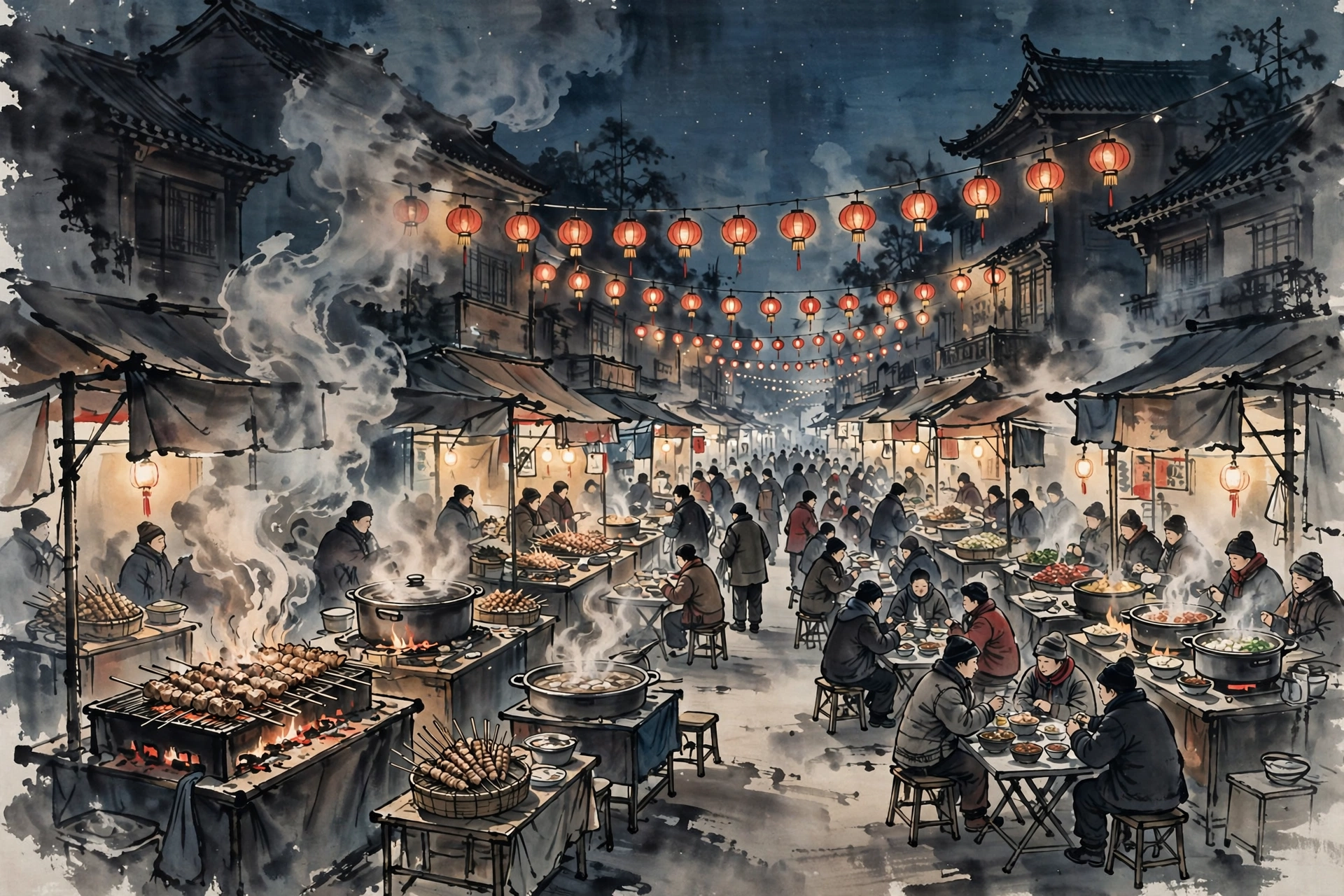
- Jilin’s night markets are open-air streets of food stalls that come alive after dark: charcoal grills, steaming pots, and crowds eating at folding tables under lanterns. In a city with almost no club scene, this is the nightlife.
- How it works: walk, point, pay by phone, sit anywhere there’s a free stool. No reservations, no menus in English, no problem.
- Eat: chuan’r skewers (lamb, chicken, squid), grilled everything, jianfen jelly noodles, and whatever the longest queue is selling — the queue is the review system.
- Cost: a full, happy evening runs about the price of one appetizer back home. See the budget guide for the math.
Why night markets, why here
Every Chinese city has night markets, so what’s special about Jilin’s? Two things: season and scale.
In summer, they’re the city’s living room — warm nights, cold beer, the whole street smelling of cumin and charcoal. In winter, they’re something rarer: steam rising off grills into −15°C air, eaters huddled in down jackets around folding tables, the food somehow tasting better for the cold. Few foreign travelers ever see a winter night market; in Jilin, you can walk into one like it’s nothing, because for the locals, it is nothing — just Tuesday.
Think of them as Southeast Asia’s hawker centres, but wilder. The cousin-not-twin part: a Singapore hawker centre is a permanent roofed food court with heritage status. A Jilin night market is seasonal and open-air, slightly feral: stalls that appear at dusk and vanish by midnight, health inspection by crowd wisdom. Same social function, completely different animal.
How a night market works (the unwritten rules)
- There is no entrance. You just… walk in off the street. The market is a street that happens to be full of food.
- Point and pay. Stalls display their goods; point at what you want, hold up fingers for quantity. Prices are posted (in Chinese); a phone calculator bridges everything.
- Sit anywhere. Folding tables and plastic stools belong to no one and everyone, so grab a free spot near the stall you ordered from. Your food finds you.
- Pay by phone. Alipay/WeChat Pay QR codes are on every stall. Cash works too. (Get the payment setup sorted before your first market night; see where to stay for the foreigner playbook.)
- The queue is the Michelin star. A stall with twenty locals waiting is never wrong. A stall with no queue at 8 PM is telling you something.
What to eat: the greatest hits
Our food guide covers Jilin’s signature dishes; the night market is where you eat their rowdier cousins:
- Chuan’r (串儿): skewers over charcoal: lamb, chicken wings, squid, mushrooms, mantou bread. Cumin, chili, salt. Order by the dozen; they’re small.
- Grilled cold noodles (烤冷面): the Korean-Chinese street classic: chewy cold-noodle sheets griddled with egg, sausage, and sweet-spicy sauce. Not the same as restaurant lengmian. This is its scrappy street sibling.
- Jianfen (煎粉): if you haven’t had it yet, the night market is the place: sizzling jelly-noodle cakes with the works. (Our food guide explains why it has no Western equivalent.)
- Stinky tofu? Present, but milder than the southern versions. The brave may proceed.
- Fruit and drinks: grilled pineapple, fresh-squeezed juices, and in summer, ice-cold local beer. In winter, hot soybean milk and roasted sweet potatoes.
The adventurous-eater rule: if you can’t identify it, watch a local eat it first. If they’re happy, you’re safe.
Beyond food
Food is 90% of it, but the other 10% is worth a stroll:
- Cheap clothing, phone accessories, and trinkets, the same goods as the day markets, marked up slightly for the atmosphere.
- Snacks to take home: vacuum-packed sausages, dried mushrooms, pine nuts from the Changbai forests.
- People-watching at its finest. The night market is where Jilin shows you who it is when nobody’s performing.
Practical tips
- When: stalls typically fire up around dusk and wind down by 10–11 PM (earlier in deep winter). Go at 7–8 PM for the full energy.
- Where: night markets shift with seasons and regulations. Ask your hotel front desk for the liveliest one right now. The downtown and station-quarter streets are the usual suspects (neighborhoods guide).
- Hygiene: eat where the turnover is high and the grill is hot. Piping-hot skewers off charcoal are among the safest street food on Earth; lukewarm pre-cooked items are where caution applies.
- Language: essentially none. Pointing, smiling, and the calculator app are a complete toolkit. “这个” (zhège, “this one”) plus a raised finger-count solves 95% of transactions.
- Winter warning: your phone battery dies fast in the cold, and your phone is your wallet. Keep it in an inside pocket between payments.
FAQ
Are night markets open in winter? Yes, the hardy ones. Fewer stalls, earlier closing, but the atmosphere (steam! frost! charcoal!) is arguably better. Dress like the packing list says.
Is it safe for a solo traveler / woman alone? Yes. Night markets are family territory — grandparents, kids, everyone. The usual travel awareness applies; nothing market-specific to fear.
Can I haggle? At food stalls, no. Prices are fixed. At goods stalls, a friendly “便宜点” (piányi diǎn — “a bit cheaper?”) is fine.
I have dietary restrictions. Can I still go? Vegetarians do fine (grilled mushrooms, corn, egg dishes, fruit). Strict vegans and the gluten-averse will work harder: sauces hide wheat and the grills share space. When in doubt, the fruit stalls are your safe harbor.
New to Jilin food? Start with what to eat in Jilin, then plan your evenings with the neighborhoods guide.