Xuandi Temple and Xuantian Ridge Guide: Jilin City's Northern Guardian
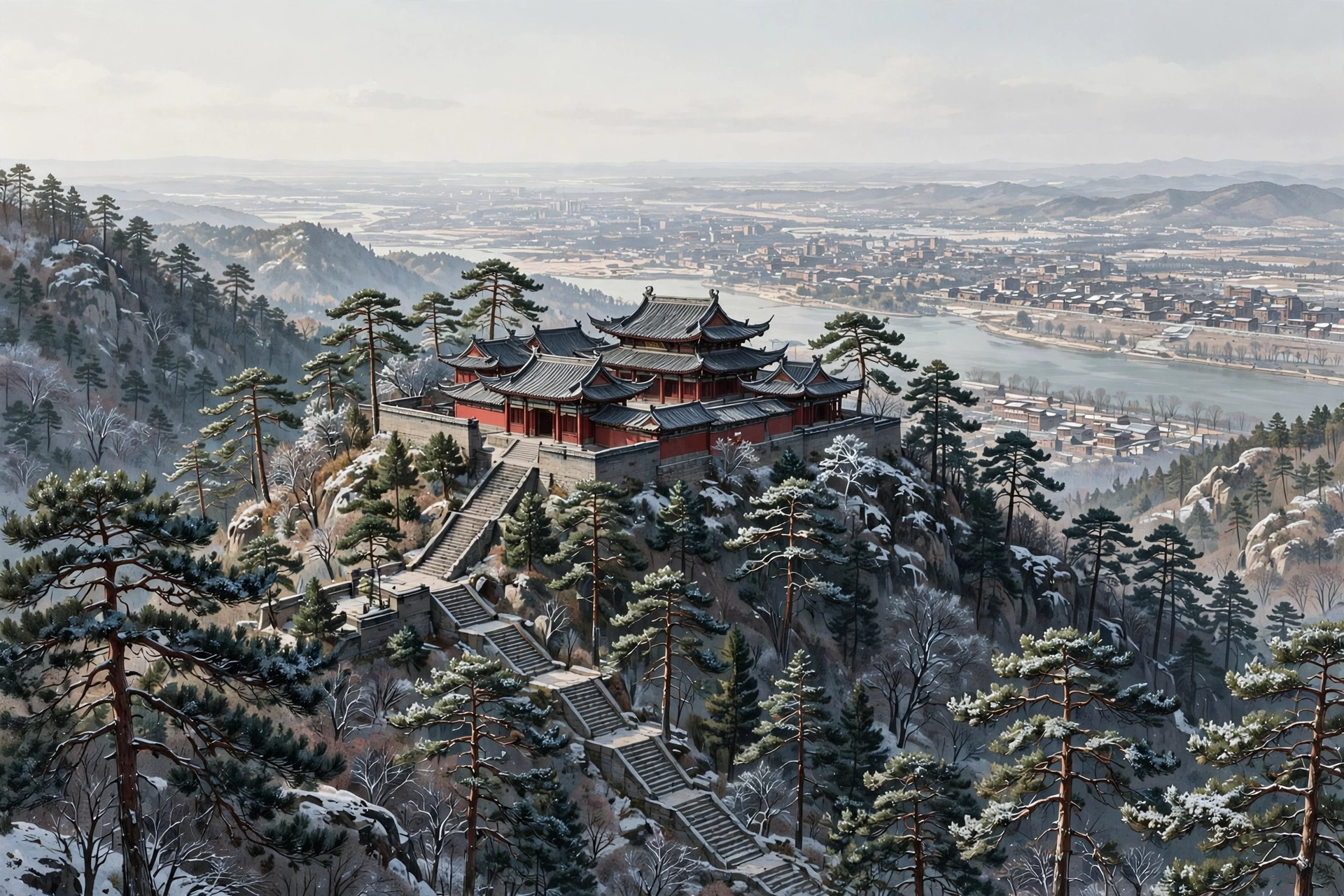
Xuandi Temple and Xuantian Ridge in 30 seconds
- What it is: A Taoist temple on a low ridge north of Jilin City, dedicated to Zhenwu, the god of the north. The temple was built in 1738, destroyed in the Cultural Revolution, and rebuilt from 2006 to 2016 on the old pattern.
- Where: Xuantian Ridge, Beiji Subdistrict, Chuanying District, north of the city centre. The ridge stands 282 metres above sea level.
- Why go: It is the one temple in Jilin City built as a guardian rather than a neighbourhood shrine. The site, the god, and the fire story behind them explain how the old city saw itself.
- Practical: Free entry. Hours are listed as 8:00 AM to 6:00 PM. Bus 53 serves the ridge. Allow 1 to 2 hours, and pair it with Beishan Park or the Manchu Museum on the same day.
At a glance
- Place: Xuantian Ridge, Beiji Subdistrict, Chuanying District, Jilin City
- Address: Xuantian Ridge, Beiji Subdistrict (no street number is published; navigate by the Chinese name 玄帝观 or 玄天岭)
- Tickets: Free
- Hours: 8:00 AM to 6:00 PM, per Wikivoyage (last updated January 2019; check at the door)
- Phone: +86 13089457166 (reception), +86 15568497528 (office); email [email protected]
- Getting there: Bus 53; see the transport guide for bus and taxi basics
- Best for: A quiet morning or an evening walk, after the city centre museums
Why a temple guards the north
Jilin City grew as a Manchu garrison town on the Songhua River, and the old city read its own map through feng shui. In that scheme the four sides of a town each have a guardian: Azure Dragon on the left, White Tiger on the right, Vermilion Bird in front, and Dark Warrior behind. The north is the Dark Warrior’s side, and the Dark Warrior is Zhenwu, the Great Emperor of the North, also called Xuantian Shangdi.
That is why a temple to Zhenwu stands on the ridge north of the city. It was placed there in 1738, the third year of the Qianlong reign, to guard the town from the north. Think of a European cathedral town with a patron saint’s church on a hill above the roofs. The shape is familiar: a sacred building watching over a town. The difference is the job. A parish church serves the people around it. This temple served the whole city as a shield, and its god is a cosmic emperor of the north rather than a local saint.
Zhenwu is one of the highest gods in Taoism, tied to Wudang Mountain far to the south. His symbols are the tortoise and the snake, and his direction is north, his season winter, his element water. A temple to a water god on a northern ridge also answered a practical fear. Jilin City burned repeatedly in the 1700s, with major fires recorded in 1742, 1759, 1763, 1790 and 1791, and the shipyard burning again in 1806. Water set against fire was the logic of the site, and the temple stood where the city felt most exposed.
Three dates: 1738, the destruction, and the rebuild
The temple’s story runs in three parts, and the present building belongs to the third.
1738. The temple was built on Xuantian Ridge in the third year of Qianlong. It is also called Zhenwu Temple, after the god it enshrines. Local histories describe a complex of three main halls, three matching verandas, six meditation halls and three Doumu pavilions, with the front hall dedicated to Zhenwu.
The Cultural Revolution. The temple was destroyed in that period, like temples across China. Nothing of the 1738 fabric survives above ground, and the ridge stood without its temple for decades.
2006 to 2016. The present structures were built in those years, modelled on the originals. Wikivoyage calls it one of the largest Taoist temples in Jilin Province, and notes that as of 2019 some buildings were still under construction. Go expecting a living temple that is still being finished, not a restored relic with a fixed story. That is part of the visit: the rebuilding is recent enough that the place still feels like a project.
What to see, in visit order
No floor plan is published in English, so walk the site in this order and let the ridge set the pace.
The climb. The ridge is 282 metres above sea level and the climb is short. Visitor reports describe an easy walk up, with local people coming for evening walks and food stalls at the foot of the hill. The climb is closer to a walk up a small hill above a market town than to a mountain hike, and the reward is a working temple rather than a viewpoint cafe. Come in the late afternoon and the ridge top opens over the northern side of the city, with the evening walkers for company.
The front hall. The front hall is dedicated to Zhenwu. Local descriptions point out one carpentry curiosity here: a beam that hangs in the air and a column that stands clear of the ground, known as the hanging beam and hanging column. Look up before you look at the statue. The trick is the point, and it is the detail local guides single out.
The Bagua on the ridge. Somewhere on the ridge is a Bagua diagram laid in blue brick, about five chi across. The Kan trigram in the diagram stands for water. Local tradition says it was set there to guard against fire, turning water against the flames that kept taking the city in the 1700s. Treat it as a folk device rather than an engineering answer: a symbol laid in the ground where the city once felt helpless.
The halls behind. The halls behind the front hall carry the rest of the complex, including the Doumu pavilions. Walk them slowly. The temple is active, so keep your voice down, dress with shoulders and knees covered, step over the thresholds rather than on them, and remember the central threshold belongs to the god. Offer three sticks of incense with three bows if you take part, and do not blow out incense with your mouth. Photography inside the halls is usually forbidden, flash included, and drones are banned. The visitor etiquette guide covers temple manners in full.
Practical information
- Address: Xuantian Ridge, Beiji Subdistrict, Chuanying District. No street number is published for the temple. Navigate by the Chinese names, 玄帝观 for the temple and 玄天岭 for the ridge.
- Hours: 8:00 AM to 6:00 PM, per Wikivoyage, last updated January 2019. No newer English hours are published, so check the notice at the door or call +86 13089457166 before a late visit.
- Admission: Free. No ticket price appears in any listing found for this guide.
- Getting there: Bus 53 runs to the ridge. By taxi, show the driver 玄帝观 or 玄天岭 on your phone. The ridge is north of the city centre, in the same subdistrict as the Jilin City Art Museum at No. 66 Beiji Street, a small municipal gallery whose opening hours are not published in English listings. Treat the art museum as a look on the way past rather than a planned stop.
- How long: Allow 1 to 2 hours for the climb, the halls, and time on the ridge top.
- When to go: Late afternoon suits the site best, for the light on the ridge and the evening walkers. Mornings are quieter. Winter adds snow to the pines and the steps, so wear shoes with grip.
- Combine with: Beishan Park and its three temples, or the Manchu Museum at No. 47 Desheng Road, both in the same northern part of the city. For the full trip plan, see the Jilin City travel guide and the things to do list.
Which temple is which
Jilin City has several temples, and the names blur together.
Xuandi Temple, on Xuantian Ridge in Beiji Subdistrict, is the Taoist temple to Zhenwu, built 1738, destroyed, and rebuilt 2006 to 2016. See this guide for that visit.
The three temples on Beishan Park are Guandi Temple from 1701, Yaowang Temple from 1738, and Yuhuang Pavilion from 1776, inside a city park with a hilltop view. See the Beishan temples guide for those.
The Confucian Temple, at No. 2 Nanchang Road, is the Qing dynasty temple to Confucius, first built 1736 and moved to its present site in 1909. See the Confucian Temple guide for that visit.
The Sacred Heart Cathedral, at No. 3 Songjiang Middle Road, is the Gothic Catholic church built by French missionaries between 1917 and 1926. See the cathedral guide for that visit.
For the wider history behind the 1738 date, read the history timeline before you go. The temple’s year sits in the same decade as the Confucian Temple’s founding and the Yaowang Temple on Beishan, which is the moment Jilin stopped being only a garrison and started building the institutions of a city.