Manchu Paper-Cutting in Jilin: Scissors, Symmetry, and Shamanic Roots
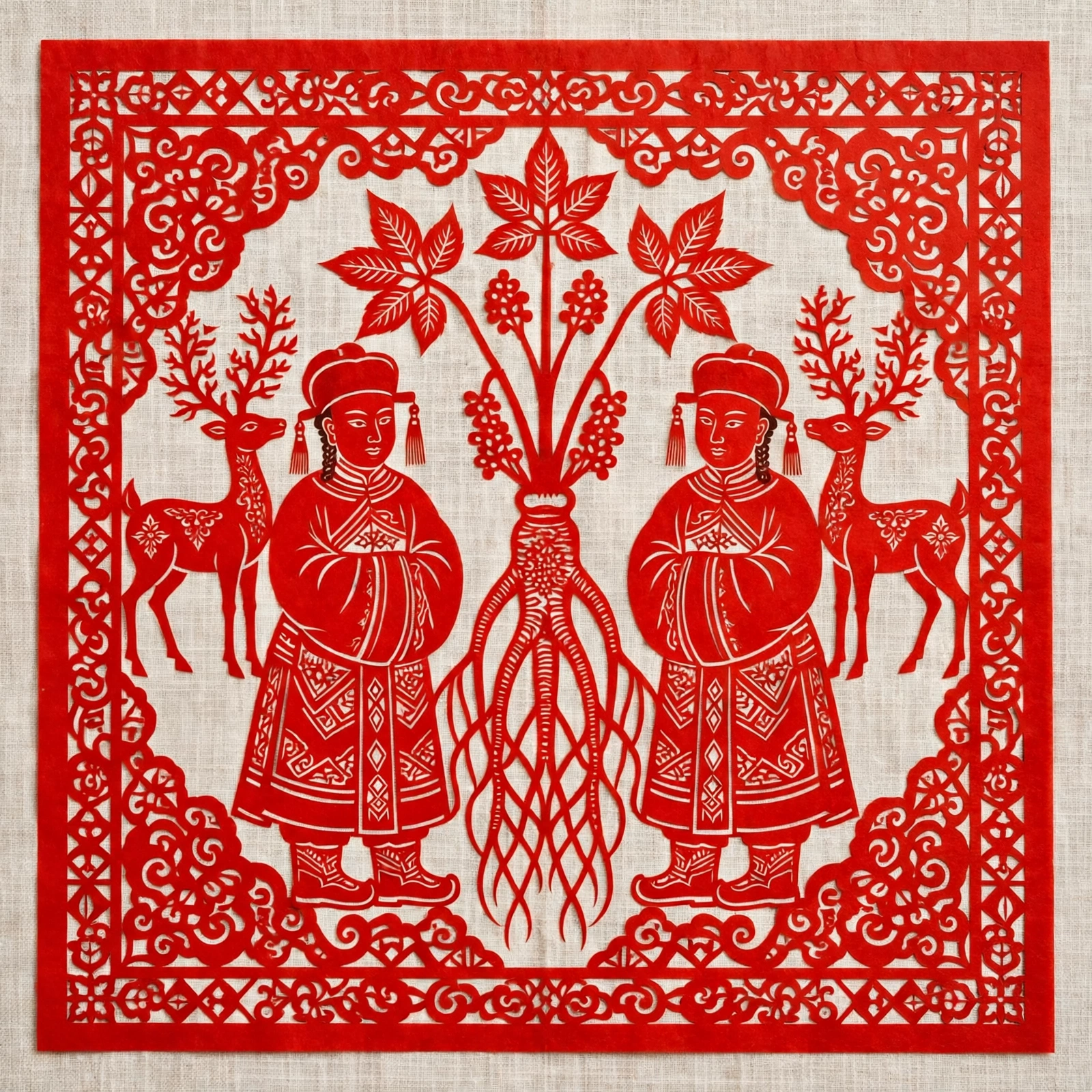
Manchu paper-cutting in 30 seconds
- What it is: A Manchu folk art from the Changbai Mountains region of Jilin Province: pictures cut freehand from red paper, with no sketch drawn first.
- Why it stands out: Much Chinese paper-cut work prizes fine, delicate lines. The Manchu style goes the other way: bold lines, strict symmetry, and figures that face you straight on. It started life as a ritual object, and only later became decoration.
- Status: Listed as a Jilin provincial intangible heritage item in 2007 and on China’s national list in June 2008. Chinese paper-cut as a whole joined UNESCO’s Representative List in 2009.
- Where to see it near Jilin City: The Jilin City Manchu Museum has an intangible heritage area with hands-on activities. The fullest collection sits further out at the Changbai Mountain Manchu Folk Art Museum.
From ritual object to window decoration
The Manchu are the people of the Changbai Mountains, and their paper-cutting grew out of Shamanism, their traditional religion. Its history traces back to the Ming Dynasty (1368-1644), when cut patterns served as carriers of religious symbols for sacrificial and praying rituals. Early makers worked patterns onto leather, fish skin, and cloth before paper became the main material.
As Manchu life settled into farming towns and festival calendars, the cuts moved with it: onto windows at Spring Festival, into wedding rooms, and onto festival displays. The old motifs came along. That is why a Manchu paper-cut still reads like a small religious painting even when it hangs in an ordinary living room window.
How to read a Manchu cut
Symmetry first. Figures stand front-facing and mirrored left to right. The order is the point. Manchu makers admired regularity, and the cut shows it.
The Momo figures. These are the signature motif: geometric, stylized human figures, often female, built from triangles and arcs. They embody the Manchu reverence for women. If a cut shows a row of flat, front-facing people that look almost like pictograms, you are looking at Momo.
Nature and the hunt. Ginseng and deer deities, eagles, snakes, ginseng gathering scenes, hunting scenes. The forest economy of the Changbai Mountains, drawn in red.
One cut, no sketch. The artist works straight onto the paper with scissors, in one continuous effort. That is why the lines look confident rather than fussy. An older branch of the tradition worked differently: some pieces were torn rather than cut, which left rough, natural edges.
If you know Mexican papel picado, you have a useful cousin for comparison. Both are festive cut paper. But papel picado is tissue in many colors, punched and strung as banners overhead, while a Manchu cut is a single sheet in a single color, symmetrical, and made to stay on a window or wall. Same family of craft, different temperament.
Where to see it and try it
Jilin City Manchu Museum. After an expansion, the museum opened exhibition areas that include an intangible heritage inheritance area, with hands-on activities alongside the displays. It is the easiest place to see the craft without leaving the city.
Changbai Mountain Manchu Folk Art Museum. The first national Manchu folk art museum, with a dedicated paper-cutting area that combines physical objects, images, scenes, and projections.
Tonghua. The Tongjiajiang Manchu paper-cutting experience runs activities in Tonghua, using the same method as the Changbai style. It is listed as a provincial intangible heritage item in its own right.
A winter bonus. The Changbai Mountain Ice and Snow Special Train has added a Manchu paper-cutting workshop, where visitors cut snow flower patterns with heritage inheritors guiding them. It pairs well with a Beidahu ski trip or a day at the winter festivals.
For the wider Manchu story in the city, the Beishan Park temples show how older beliefs layered into local religious life, and Rime Island sits in front of Wula Street, the Manchu town behind the island.
Buying one: what to look for
Museum shops and folk craft stalls in the region sell paper-cuts. Look for single-sheet red cuts with front-facing, symmetrical figures. Slight irregularities in the line are a good sign: they mean a hand did the work. Perfectly identical pieces in a stack are printed, and they miss the whole point of the craft.
FAQ
Is Manchu paper-cutting on UNESCO’s list? Not separately. Chinese paper-cut as a whole was inscribed on UNESCO’s Representative List in 2009. The Changbai Manchu tradition is on China’s national intangible heritage list, since June 2008.
Can a beginner try it? Yes. The museum hands-on areas, the Tonghua experience activities, and the train workshop all let visitors try simple patterns. Snow flowers are the usual first cut.
How is it different from other Chinese paper-cutting? Three things: bolder lines where other regions go delicate, strict front-facing symmetry, and a motif vocabulary that comes from Shamanic ritual and the hunting life of the Changbai forests rather than from farming or court decoration.
When is the best time to see it? Winter works well. The craft appears in festival displays around Spring Festival, and the train workshop and winter festival programming give you the most chances to watch a maker at work. The museums show it year round.