Jilin Meteorite Museum: Touch a Rock Older Than Earth Itself
The essentials in 30 seconds
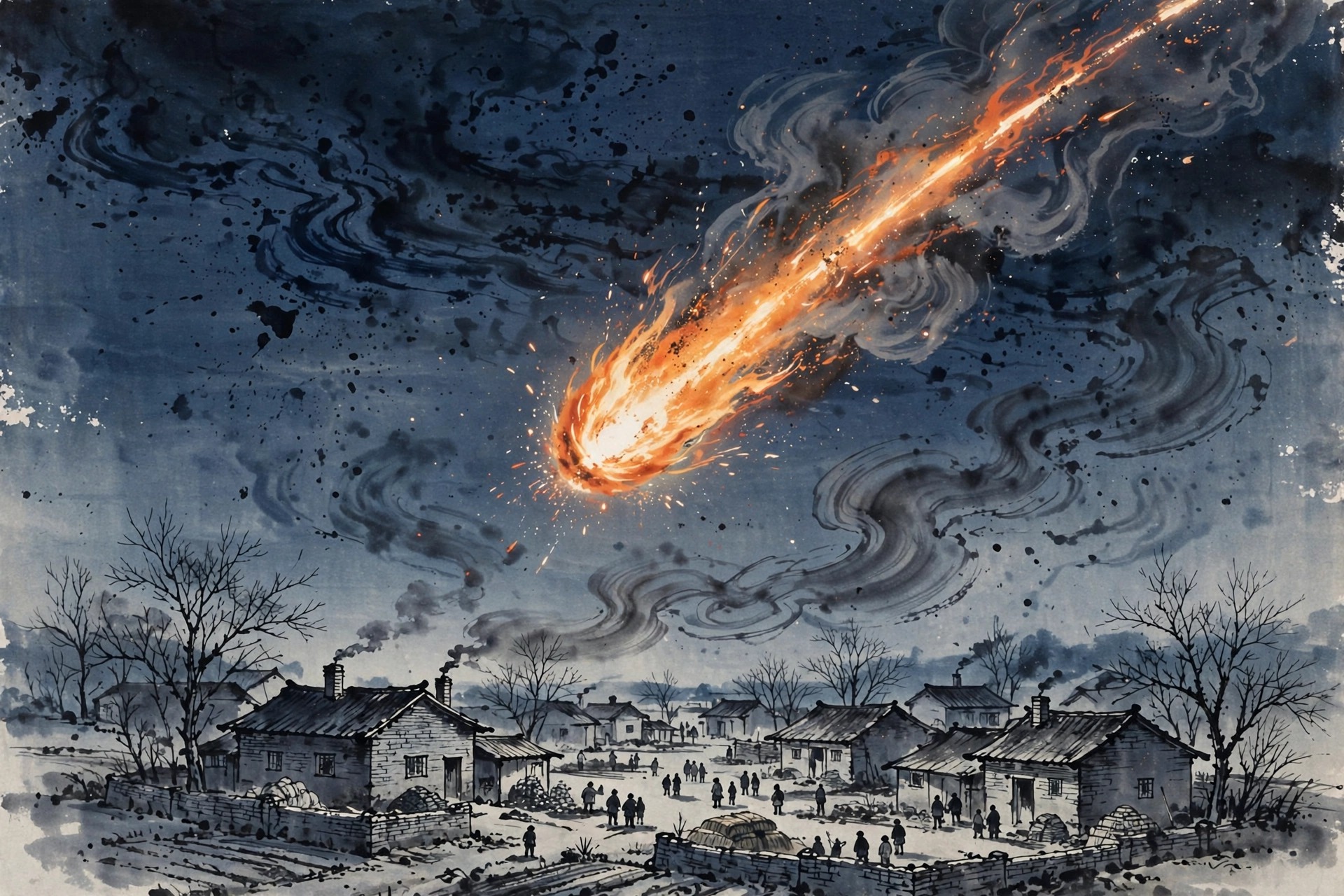
- What happened: On March 8, 1976, a fireball tore over Jilin and shattered 19 km up, raining 138 meteorites across 500 square kilometers — the largest witnessed meteorite shower in recorded history.
- The star: Jilin No. 1, weighing 1,770 kg — the largest single stony meteorite ever found on Earth. It’s here, in this museum, and you can stand next to it.
- The museum: China’s first purpose-built meteorite museum, on the south bank of the Songhua River. Half a day, easy to combine with a riverfront walk.
The afternoon the sky fell
At about 3:02 PM on March 8, 1976, villagers north of Jilin City heard what they first took for thunder — then looked up and saw daylight turn theatrical. A fireball “with an ear-splitting roar” crossed the sky, broke apart high in the atmosphere, and scattered stones across the frozen fields of Yongji County.
The numbers from that afternoon are still startling:
- 500 square kilometers of strewn field — stones falling across an area the size of a mid-sized city.
- 138 intact specimens recovered, plus over 3,000 fragments, totaling more than 2,700 kg.
- The largest crater was 2 meters across and 3 meters deep, punching through 6.5 meters of frozen soil. The impact registered like a magnitude 1.7 earthquake; witnesses reported a mushroom cloud and dirt thrown 150 meters.
- Nobody was hurt. No houses destroyed. For the largest rockfall in witnessed history, Jilin got off lightly.
If you remember the Chelyabinsk meteor of 2013 — the Russian fireball caught on a thousand dashcams, the shockwave that injured 1,500 people — Jilin is its stranger cousin. Chelyabinsk’s rock exploded in the air and rained glass-shattering chaos on a city; Jilin’s broke high and fell as recoverable stones onto empty farmland. Scientists dream of Chelyabinsk footage and Jilin specimens: one gave us the video, the other gave us the rocks.
Why scientists still care
The Jilin meteorite is an H5 chondrite — a stony meteorite, the most common kind, but this one is special for three reasons:
- It was witnessed. Most meteorites are found years later, anonymous rocks in a desert. Jilin fell in front of thousands of people at a recorded second — 15:02:36 — with its trajectory, breakup altitude, and strewn field all documented. That context makes every gram more valuable to science.
- It’s ancient. Analysis shows the parent asteroid was 4.6 billion years old — older than Earth itself, a leftover building block from the solar system’s formation, drifting in the asteroid belt between Mars and Jupiter until its orbit decayed.
- It’s the biggest of its kind. Jilin No. 1, at 1,770 kg, is the largest single stony meteorite known — roughly the weight of a small car, in one unbroken rock from space.
Small pieces of Jilin exist in museums worldwide — a couple hundred grams in London, a couple hundred in Washington. But the mountain stayed home.
Inside the museum
The Jilin Meteorite Museum (吉林市陨石博物馆) sits on the south bank of the Songhua River, near Jilin Bridge — fittingly, within sight of the river the city is named for.
- Jilin No. 1 — the 1,770 kg main mass, displayed like the celebrity it is. Photos don’t prepare you; it’s the size of a large desk, pitted and blackened, and it fell out of the sky.
- Jilin No. 2 — 126 kg, and you’re allowed to touch it. Few museums on Earth let you lay hands on a witnessed fall.
- Jilin No. 3 and 41 meteorite specimens from falls around the world, for comparison.
- Exhibits on how meteorites form, solar-system science, and the full documentary record of the 1976 shower — graphs, analysis, and the crater story.
Allow 2 hours. The science exhibits are visual enough to enjoy with minimal Chinese, though an English-speaking guide (arranged via your hotel) deepens it considerably.
Practical tips
- Combine it with a Songhua riverfront walk — the museum’s riverside location makes this natural. See the travel guide for the riverfront route.
- Photography is normally allowed; flash policies vary by hall — check signs.
- Souvenirs: the museum shop sells small certified meteorite fragments. They’re genuine conversation pieces — a rock older than the planet, in your pocket. Prices vary; buy only from the official shop, as China’s meteorite market is famously full of fakes.
- With kids? This is one of Jilin’s best family stops — space rocks beat another temple for the under-12 crowd.
FAQ
Is it really the world’s largest? The largest single stony meteorite, yes — 1,770 kg, and the largest witnessed stone fall by total recovered mass. (Iron meteorites can be bigger — Antarctica’s got monsters — but among stones that fell while people watched, Jilin stands alone.)
Can I see where they fell? The strewn field is farmland in Yongji County, north of the city — there’s no visitor center at the fall site itself. The museum is the experience.
Is the museum English-friendly? Partially — key labels have English, but the deeper science panels are Chinese-heavy. The rocks themselves need no translation.
Part of our Culture & Heritage series. For the full trip plan, see the Jilin City Travel Guide and 2-day itinerary.